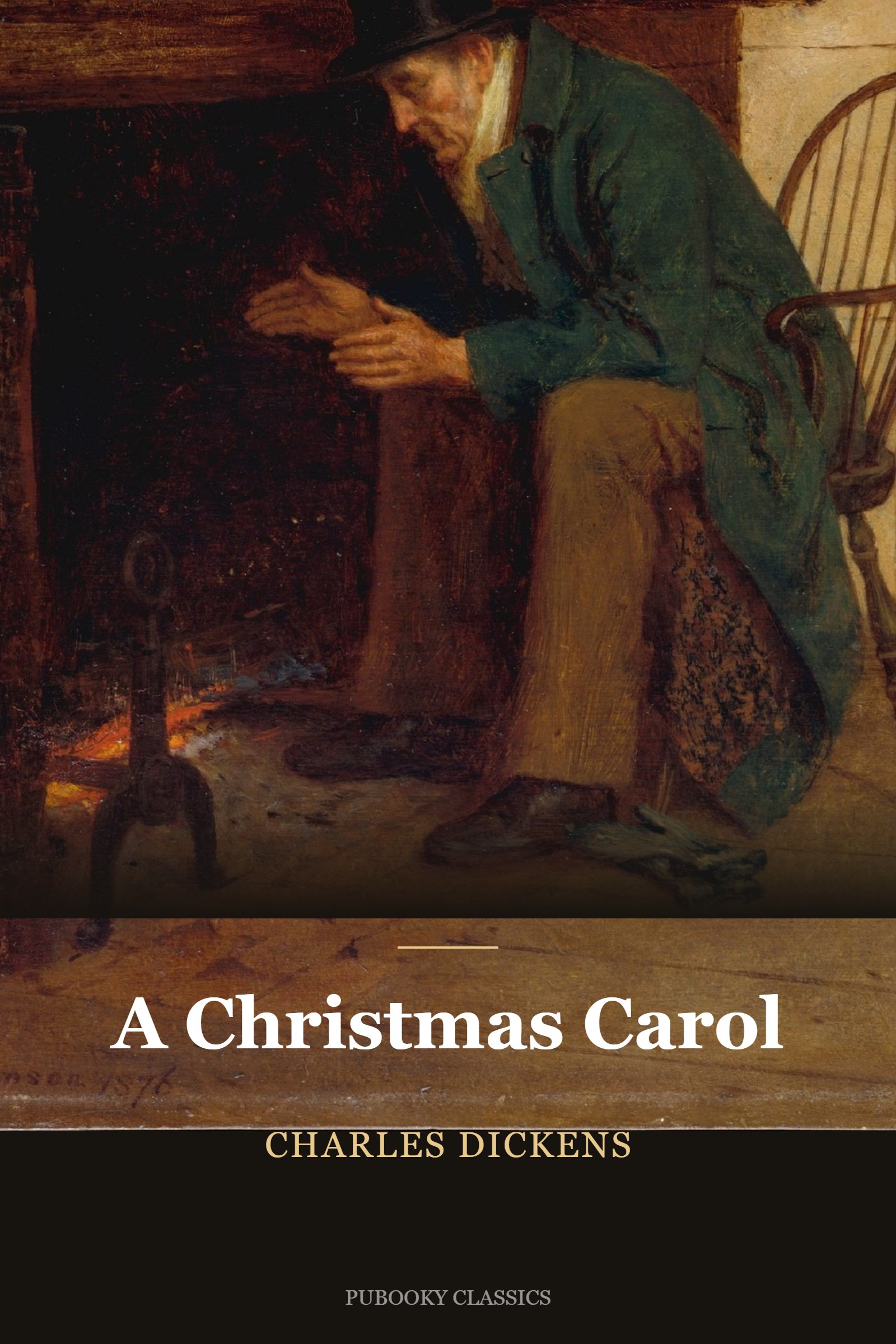
A Christmas Carol
Free
On Christmas Eve, the miserly Ebenezer Scrooge is visited by the ghost of his old business partner — and then by three spirits who show him his past, his present and the future that awaits him. Charles Dickens's beloved story…
Free shipping on orders over $50!
- Satisfaction Guaranteed
- No Hassle Refunds
- Secure Payments
On Christmas Eve, the miserly Ebenezer Scrooge is visited by the ghost of his old business partner — and then by three spirits who show him his past, his present and the future that awaits him. Charles Dickens's beloved story of kindness and second chances.
This free Pubooky Classics edition is based on the public-domain text produced by Standard Ebooks.
Read a sample: Stave I: Marley’s Ghost
Marley was dead, to begin with. There is no doubt whatever about that. The register of his burial was signed by the clergyman, the clerk, the undertaker, and the chief mourner. Scrooge signed it. And Scrooge’s name was good upon ’Change for anything he chose to put his hand to. Old Marley was as dead as a doornail.
Mind! I don’t mean to say that I know of my own knowledge, what there is particularly dead about a doornail. I might have been inclined, myself, to regard a coffin nail as the deadest piece of ironmongery in the trade. But the wisdom of our ancestors is in the simile; and my unhallowed hands shall not disturb it, or the country’s done for. You will, therefore, permit me to repeat, emphatically, that Marley was as dead as a doornail.
Scrooge knew he was dead? Of course he did. How could it be otherwise? Scrooge and he were partners for I don’t know how many years. Scrooge was his sole executor, his sole administrator, his sole assign, his sole residuary legatee, his sole friend, and sole mourner. And even Scrooge was not so dreadfully cut up by the sad event but that he was an excellent man of business on the very day of the funeral, and solemnised it with an undoubted bargain.
The mention of Marley’s funeral brings me back to the point I started from. There is no doubt that Marley was dead. This must be distinctly understood, or nothing wonderful can come of the story I am going to relate. If we were not perfectly convinced that Hamlet’s father died before the play began, there would be nothing more remarkable in his taking a stroll at night, in an easterly wind, upon his own ramparts, than there would be in any other middle-aged gentleman rashly turning out after dark in a breezy spot—say St. Paul’s Churchyard, for instance—literally to astonish his son’s weak mind.
Scrooge never painted out Old Marley’s name. There it stood, years afterwards, above the warehouse door: Scrooge and Marley. The firm was known as Scrooge and Marley. Sometimes people new to the business called Scrooge Scrooge, and sometimes Marley, but he answered to both names. It was all the same to him.
Oh! but he was a tight-fisted hand at the grindstone, Scrooge! a squeezing, wrenching, grasping, scraping, clutching, covetous old sinner! Hard and sharp as flint, from which no steel had ever struck out generous fire; secret, and self-contained, and solitary as an oyster. The cold within him froze his old features, nipped his pointed nose, shrivelled his cheek, stiffened his gait; made his eyes red, his thin lips blue; and spoke out shrewdly in his grating voice. A frosty rime was on his head, and on his eyebrows, and his wiry chin. He carried his own low temperature always about with him; he iced his office in the dog-days, and didn’t thaw it one degree at Christmas.
External heat and cold had little influence on Scrooge. No warmth could warm, no wintry weather chill him. No wind that blew was bitterer than he, no falling snow was more intent upon its purpose, no pelting rain less open to entreaty. Foul weather didn’t know where to have him. The heaviest rain, and snow, and hail, and sleet could boast of the advantage over him in only one respect. They often “came down” handsomely, and Scrooge never did.
Nobody ever stopped him in the street to say, with gladsome looks, “My dear Scrooge, how are you? When will you come to see me?” No beggars…
Related products
-
The Time Machine
Free -
-
The Call of the Wild
Free -
The Great Gatsby
Free -
Reviews
There are no reviews yet.